
I first invested in Bitcoin back in 2013.
It wasn’t a huge amount, but I was in.

At the time, I was living in San Francisco, working at a company called Monkey Inferno.
Monkey Inferno was owned by Michael Birch—the man who famously sold Bebo.com to AOL for an eye-watering $850 million in 2008.
Just five years later, in the very week I joined the company, he bought Bebo back for only £1 million.
Quite the story, right?
Our mission? Rebuild Bebo.com from the ground up.
We experimented endlessly, following the lean startup model, spinning out idea after idea.
We tried reinventing WhatsApp, creating a simpler version of Reddit, even building a Q&A video platform.
Every week, a new, shiny project emerged. But despite our relentless efforts, none of our creations seemed to generate lasting value.
Meanwhile, Bitcoin was bouncing between $300 and $1,000, creating a buzz throughout tech circles.
Our office had 22 people, and at least one was completely hooked on crypto.
At the time, I knew next to nothing about it, nor did I particularly care.
But in San Francisco—the beating heart of the tech world—crypto was everywhere, dominating conversations.
I lived in what we called a hacker house: three bedrooms packed with 15 bunk beds.
It was more like an orphanage with Wi-Fi, and everyone was obsessed with debating Bitcoin’s future.
Some even launched their own crypto startups.
Still, it took me another two years to really understand the potential of digital currency.
More on that in a moment…
My Trading Philosophy
I’m no financial guru, but I’ve developed two core investment strategies:
- “Time in the market beats timing the market.” — Kenneth Fisher
- “The time to buy is when there’s blood in the streets.” — Baron Rothschild
Let’s tackle the first point.
Timing the market is almost impossible. You’ll rarely buy at the absolute bottom or sell at the peak.
For me, the key has been setting up regular, automated investments.
Every month, I invest a fixed amount—something I’m prepared to lose—into stocks or crypto I believe in.
This approach removes emotion from the equation.
When the media bombards us with fear—global crises, financial meltdowns, or economic disasters—that’s when I increase my investment.

So, if I usually invest $50 in Ethereum every Friday, during a crisis, I’ll boost it to $100, $250, or even $500.
When markets are gripped by fear, every instinct screams that prices could drop further or that your investment will collapse.
But sticking to this strategy helps manage those emotions.
The Emotional Battle
Humans are inherently irrational, especially when fear is in the air.
By consistently investing throughout the year and ramping up when panic strikes, I’ve learned to keep emotions in check.
Investing, I’ve discovered, is more about mastering human psychology than understanding numbers.
When to Sell?
Getting out is just as hard as getting in.
You’ll almost never sell at the exact peak, just as you’ll rarely buy at the bottom.
We’re social creatures. FOMO (fear of missing out) is deeply ingrained in us from childhood.
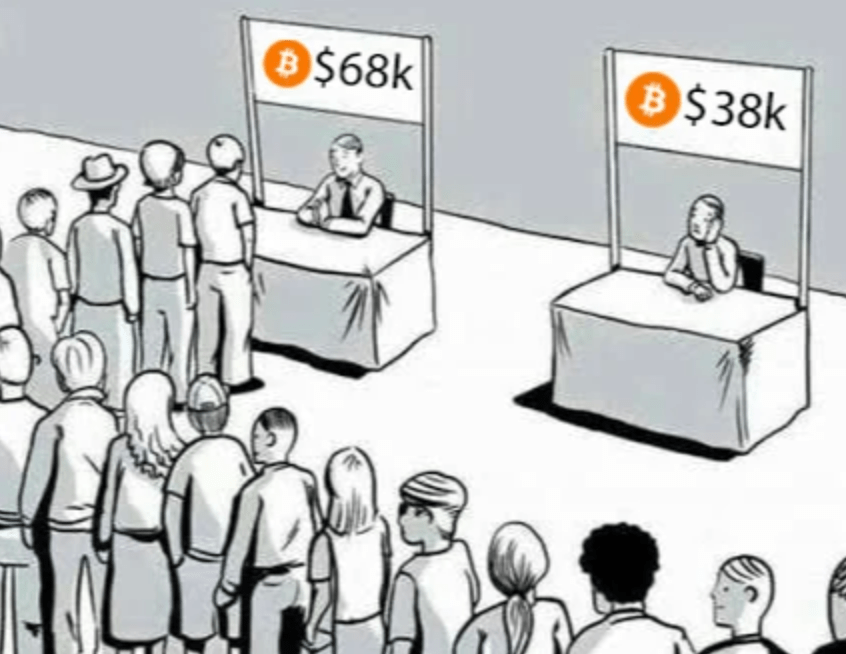
Remember when you never wanted to miss a party as a kid?
We crave connection and validation.
In markets, this herd mentality can be dangerous.
The Streets Whisper a Melody
Listen closely to the world around you.
If people in coffee shops can’t stop talking about X..
Or friends text you, “Have you seen the price of Y?”
It’s probably time to consider selling or averaging out.
When the general public/ high street is buying, the professionals are likely cashing out.
As Warren Buffett wisely says: “Be greedy when others are fearful.”
And the reverse is equally true: “Be fearful when others are greedy.”
Markets run on human emotion.
Why I Think Bitcoin Has Value
Since 2008, I’ve had a passion for trading Banksy artwork.
Being from Bristol, his street art has always resonated with me.

In 2015, while negotiating with an American seller for a Banksy piece, Bitcoin’s value suddenly made sense.
I need to send money to buy the painting and got hit by a ton of pain points.. I had to:
- Drive to my bank and book an appointment with the manager.
- Present my passport and explain the international transfer.
- Pay a $50 fee for the service.
- Lose around $200 in currency conversion.
- Wait 10 business days for the payment to arrive.
It ended up taking 21 days because they ended up loosing the payment.
It was a nightmare. 0/10 experience.
Bitcoin, in contrast, could have sent the money in under 60 seconds for less than $1.
I didn’t use it at the time—setting it up was complicated. Both parties needed a digital wallet or trading platform.
But the potential was clear.
Another Example:
My brother lives in Nairobi, Kenya.
Where should he store his savings?
- Land: The government could seize it.
- Local bank: Risk of bank failure.
- Gold: Expensive to store and easy to steal.
- Cash: Susceptible to theft or inflation.
Bitcoin, unlike gold, has a finite supply—only 21 million coins.
He can cross any border with his money accessible via a simple password, ready to use instantly.
For people in less economically developed countries, Bitcoin acts as a global bank, free from the risks of local corruption.
Other Observations
The best startup ideas often lie in that sweet spot of “a good idea that looks like a bad one.” You want most people to dismiss it until it becomes massive. — Sam Altman
“No conflict, no interest.” — John Doerr
Talking about crypto often provokes strong reactions.
People either call it a scam or invest heavily in it. There’s rarely a middle ground.
I found it fascinating how the smartest people I know were either obsessed with it or completely dismissive.
This split reaction made me pay closer attention, inspired by Sam Altman’s idea that sometimes, the best opportunities are the most divisive.
Final Thoughts
“An asset is what a wealthy person is willing to pay for it 10 years from now.” Unkown
Volatility is real. Bitcoin’s price can swing wildly compared to gold, which many see as a more stable investment.
From 2014 to 2024, the average UK inflation rate has been 2.74%.
Printing money is a reality that won’t go away, but you can’t print more Bitcoin.
If you had £100,000 in 2014, it would be worth only £82,034.83 in today’s purchasing power.
Is cash an asset? Does it have a use case? Of course.
But is it a great store of value? I would argue no.
Bitcoin might one day simplify to the point where it’s as seamless as PayPal for global transactions.
But I do not beleive Bitcoin will be used like cash.
I see it as a legitimate store of value.
Is it a total scam or a genuine asset?
That’s for you to decide.
But now, at least, it’s an option.
 The Most Beautiful Game